How Electric Lighting Changed the Shape of the Home
How electric lighting changed domestic rooms by moving illumination from tended flames into the building, and what old switches and fittings reveal today.
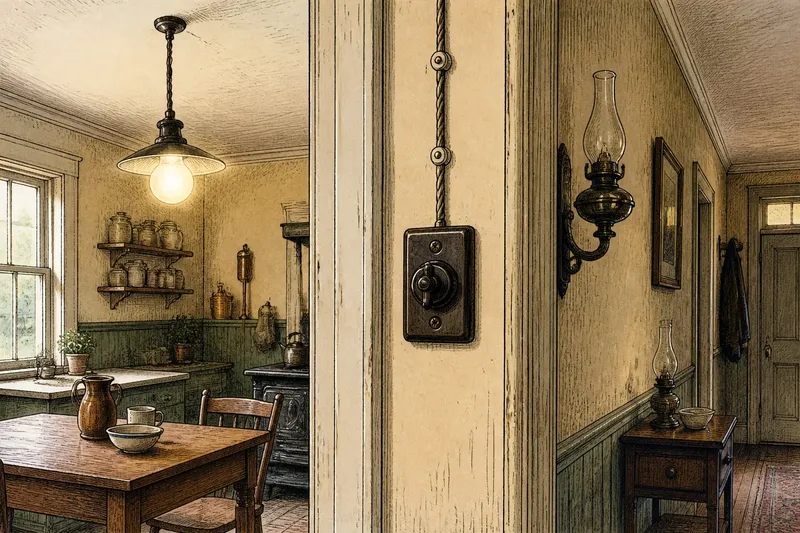
At dusk, a candle had to be lit before a room could be used; an electric switch made light available from the wall. The history of domestic lighting is not a simple march from flame to bulb, but a gradual change in how homes supplied and controlled illumination.
Candles, oil lamps and gas lighting continued alongside electric fittings in many places. Access and adoption varied, so the shift happened unevenly. Its most visible legacy is architectural: wiring, switches and lamp points made lighting part of the house rather than an object that always had to be brought into a room.
What did flame-based lighting require?
Candles and oil lamps produced light through combustion. They needed fuel, a stable place to stand and attention during use. Gas lighting also depended on a supply and suitable fittings. The practical details differed, but these sources were not simply activated by pressing a wall switch.
A household’s arrangement depended on the source, the room and the task. A candle could be set on a table; an oil lamp could be carried, with care. These possibilities do not establish a single pattern of historical behaviour. Household customs varied, and surviving equipment alone cannot tell us exactly how people organised every evening.
How did electric lighting change the building?
With electrical wiring and fittings, a bulb could be powered at a fixed point and operated by a switch. Light no longer had to travel with a person each time a different room needed illumination. The source could be attached to the ceiling or wall, while the control sat at a convenient place in the room.
This altered the house’s infrastructure. Wiring ran through the building, switches became part of its walls, and lamp holders provided points for electric light. A ceiling fitting could free a table from the job of holding a lamp. A wall fitting could serve a passage without anyone having to carry a flame through it.
Electricity did not make every room evenly lit. Where light fell still depended on the fitting, its position and the room itself. The change was that a household could supply light through installed infrastructure, rather than relying only on separate sources that needed handling and fuel.
Why was adoption gradual?
Electric lighting required access to a supply and work to install wiring and fittings. Those conditions differed between locations and buildings. In some homes, electric light arrived in selected rooms before other spaces were connected; older sources could remain in use during the transition.
That overlap is easy to miss when the past is described as a clean handover from candle to bulb. In practice, households had different circumstances and did not necessarily change every room or routine at once. The presence of a single electric fitting would not mean that all other lighting had disappeared.
Nor can a fitting on its own tell us how often it was used or who controlled it. A careful account distinguishes what the hardware shows—such as a fixed light point—from claims about everyday habits, which need more specific evidence.
What do old switches and fittings tell us?
A switch beside a doorway shows how a control can be placed where someone enters or leaves. A ceiling rose or wall fitting shows where the building could support a light source. These details help explain how electric illumination became integrated with the house, though they do not reveal every reason a particular fitting was chosen.
To examine a room, note the visible features rather than assigning them a story they cannot support:
- If a switch is near an entrance, the room can be lit from that point; if it is elsewhere, consider how someone would reach it before crossing the room.
- If a ceiling fitting is present, it shows a fixed point for light; if there is no visible fitting, do not assume the room was always dark or lacked another source.
- If an old wall fitting remains, record its position and type; if its function is unclear, avoid identifying it as electric, gas or another source without suitable evidence.
- If wiring is visible or appears altered, treat that as a clue to changes in the building; if its date or purpose matters, consult a qualified electrician or an informed local historian.
- If a room has more than one kind of fitting, note that combination; if you are describing its history, allow for overlapping changes rather than claiming a complete conversion.
- If a portable lamp is present, it shows that a movable source is available now; if you are inferring past practice, seek supporting evidence instead of treating the lamp as proof of an earlier routine.
What questions help explain domestic electric lighting?
Did electric light immediately replace candles and oil lamps?
No. The shift depended on local access and installation, and older sources could remain in use alongside electric fittings. A home might adopt electricity in stages rather than changing every room at once.
Why did the switch matter as well as the bulb?
The bulb produced light, while wiring and a switch made it available at a fixed point in the house. The control changed how a person could operate that source without carrying it from place to place.
Can an old fitting reveal how a household used a room?
It can show where a light source was installed, but not by itself how often the room was used or what people did there. Those claims need evidence beyond the fitting’s location.
Does a ceiling light explain how bright a room was?
Not on its own. The fitting’s position and design affected how light spread, and other sources may also have been used. Treat the fitting as evidence of a light point, not a complete record of the room’s illumination.
How can you describe the change without overclaiming?
Say you are examining a hypothetical house with a switch beside the kitchen doorway, a ceiling fitting in the kitchen and an older oil-lamp bracket in the adjoining hall. First, record those three visible details without assigning dates. Next, check any reliable building records for when the wiring and fittings were installed. If the records date the kitchen wiring but say nothing about the bracket, the supported account is that the kitchen had electric provision by that recorded date while the hall’s earlier use remains uncertain. The trade-off is straightforward: the description is narrower, but it does not turn an unexplained object into a claim about a family’s routine.
Domestic lighting history is clearest when the evidence is kept in view. A switch, wire or fitting can show how a house made electric light available; it cannot, by itself, tell us how every household lived. From flame to switch, the durable change was the building’s new role as part of the lighting system.